
<?xml version="1.0" encoding="utf-8"?><feed xmlns="http://www.w3.org/2005/Atom" ><generator uri="https://jekyllrb.com/" version="3.10.0">Jekyll</generator><link href="https://www.rkcosner.com/feed.xml" rel="self" type="application/atom+xml" /><link href="https://www.rkcosner.com/" rel="alternate" type="text/html" /><updated>2025-11-25T18:54:29+00:00</updated><id>https://www.rkcosner.com/feed.xml</id><title type="html">Ryan K. Cosner</title><subtitle>Ryan K. Cosner&apos;s Personal Website</subtitle><author><name>Ryan K. Cosner</name></author><entry><title type="html">Tufts SPARC (Safe &amp;amp; Performant Autonomous Robotics &amp;amp; Control) Lab Q&amp;amp;A</title><link href="https://www.rkcosner.com/q_and_a/" rel="alternate" type="text/html" title="Tufts SPARC (Safe &amp;amp; Performant Autonomous Robotics &amp;amp; Control) Lab Q&amp;amp;A" /><published>2025-08-29T00:00:00+00:00</published><updated>2025-08-29T00:00:00+00:00</updated><id>https://www.rkcosner.com/q_and_a</id><content type="html" xml:base="https://www.rkcosner.com/q_and_a/"><![CDATA[<h2 id="question-and-answers-for-sparc-lab-researchers">Question and Answers for SPARC Lab Researchers</h2>
<p>Here you can find relevant information about what it is like to be a member of the lab. Click on the questions to see the answers.</p>

<h2 id="about-us">About Us</h2>
<hr />

<details>
  <summary><b>What does "SPARC" mean?</b></summary>

  <div>

    <p>“SPARC” stands for “<strong>S</strong>afe and <strong>P</strong>erformant <strong>A</strong>utonomous <strong>R</strong>obotics and <strong>C</strong>ontrol.</p>

    <p>The “SPARC” is pronounced in the same way as “spark” and is a reference to the spark of innovation that drives our ideas and the spark of electricity that drives our robots.</p>

    <p><!-- to the *src* folder commonly found in robotics code and programming projects in general. Just as the *src* folder holds the most foundational code that everything else builds on, the SRC Lab focuses on fundamental theory and algorithms that will serve as the foundation for safe and reliable robotic systems.   --></p>

  </div>
</details>

<hr />

<details>
  <summary><b>What is the lab's balance of theory, software, and hardware?</b></summary>

  <div>

    <p>In our lab we need to do a little bit of everything. As academic researchers, we develop theory for “<em>why</em>” things should work. As roboticists, we make the theory work in practice through software and hardware implementation.</p>

    <p>Robotics requires a range of abilities and every person will have different skills and preferences. What is important is that you have an interest and respect for every part of the process: theory, software, and hardware. We can always learn what we need to know along the way!</p>

  </div>
</details>

<hr />

<h2 id="research">Research</h2>

<hr />

<details>
  <summary><b>What classes would be useful to do research with SPARC? What should I read to get started?</b></summary>

  <div>

    <p>Our research bridges robotics, control theory, and machine learning, so it is useful to have a background in each of those three subjects as well as a solid understanding of the underlying math.</p>

    <p>In terms of math our work relies on: linear algebra, differential equations, analysis, optimization, and probability theory. But you don’t need to know all of this on day one! You’ll pick up what’s important along the way.</p>

    <p>Here are some great resources to get you started if you haven’t had the opportunity to take these classes yet: <a href="https://www.math.uwaterloo.ca/~hwolkowi/matrixcookbook.pdf">the matrix cookbook</a>, <a href="http://ndl.ethernet.edu.et/bitstream/123456789/88631/1/2015_Book_UnderstandingAnalysis.pdf">understanding analysis</a>, <a href="https://web.stanford.edu/~boyd/cvxbook/bv_cvxbook.pdf">convex optimization</a>, <a href="https://www.cds.caltech.edu/~murray/books/AM08/pdf/am08-complete_22Feb09.pdf">feedback systems</a>, <a href="https://www.youtube.com/@Eigensteve">Steve Brunton’s youtube channel</a>.</p>

    <p>Also, for more academic resources, you can check out our <a href="/library/research-library/">research library</a> page.</p>
  </div>
</details>

<hr />

<details>
  <summary><b>What non-classroom skills and knowledge are useful for research in the lab? </b></summary>

  <div>
    <p>For work in the lab it is useful to have familiarity with software languages and packages including: C++, Python, Matlab, ROS2, Docker, pyTorch, the C++ Eigen matrix library, openCV, IsaacSim, MuJoCo. It isn’t expect that you have familiarity with all of these, but it’s useful to know what they are.</p>

    <p>For hardware and design knowledge, it can be very helpful if you’re familiar with 3D design tools (e.g., solidworks) and manufacturing methods (e.g., 3D printer, laser cutter, water jet cutter, mill, lathe, CNC) as well as having a familiarity with standard hand tools (e.g., drills, wrench, allen keys) and electronics (e.g., soldering, circuit design).</p>

    <p>Also, a <strong>huge</strong> part of science is in communicating results, so therefore it is critical that we, as researchers, develop our communication skills. This includes public speaking and designing slide decks for presentations. Video editing and figure design are also surprisingly important skills for a robotics researchers as videos and figures can really help to communicate a result. For scientific communication in math, it is incredibly useful to know how to use latex and I would recommend using <a href="https://www.overleaf.com/">Overleaf</a> as your latex editor that has a lot of google-docs-style functionality.</p>

  </div>
</details>

<hr />

<details>
  <summary><b>What skills/traits does Prof. Cosner and SPARC Lab look for in PhD applications? </b></summary>

  <div>
    <p>I think that the purpose of a PhD is to <i>learn how to be a researcher</i>. Therefore, while specific technical skills are important, what matters more is your ability to acquire new ones. I think that the three most important qualities for a PhD student are <b>passion</b>, <b>perseverance</b>, and <b>ability to collaborate</b>. While courses and grades in a relevant field can reflect these traits, I also value things like personal projects, statements of purpose, community outreach, work experience, and more. I try to assess applicants holistically and avoid letting any single factor (e.g. GPA or test scores) etc. carry too much weight. </p>
  </div>
</details>

<hr />

<details>
  <summary><b>What are the labs standard research submission venues? Who gets to travel there?</b></summary>

  <div>
    <p>SPARC Lab generally publishes our research at the following venues:</p>
    <ul>
      <li>Control Theory Venues:
        <ul>
          <li>CDC (spring deadline, international control conference), ACC (fall deadline, American control conference), LCSS (short-form journal), TAC (long-form journal)</li>
        </ul>
      </li>
      <li>Robotics Venues:
        <ul>
          <li>RSS (winter deadline, small + prestigious conference), IROS (spring deadline, large international conference), ICRA (fall deadline, large international conference), RAL (short-form journal), TRO (long-form journal)</li>
        </ul>
      </li>
      <li>Machine Learning:
        <ul>
          <li>CORL (summer deadline, robotics + learning conference), L4DC (late fall deadline, control + learning conference), ICML (winter deadline, large learning conference)</li>
        </ul>
      </li>
    </ul>

    <p>Lead author’s of accepted research submissions will be funded by the lab to present their work at the associated conference.</p>
  </div>

</details>

<hr />

<!-- <details>
  <summary><b>What are some of the lab's guiding philosophies?</b></summary>
  
  <div markdown="1">
    - "Build it, break it, fix it."
    - "All models are wrong, but some are useful" - George E. P. Box
    - "Sometimes proving things in control theory is like playing Pokemon. You could try and catch them all, but that's not really the point." - Andrew Taylor
    - "Just because the result is correct, it does not mean it should be published" - Magnus Egerstedt
    * "Code is cheap, show me the hardware" - Magnus Egerstedt
    - "Ultimately, a PhD is an acadedmic program. It's goal is not to produce ***research*** it is to produce ***researchers***. If you come in everyday and learn something knew, then you're succeeding" - Raffaello D'Andrea
  </div>
</details> -->
<!-- 

<hr> -->

<h2 id="student-expectations">Student Expectations</h2>
<hr />

<style>
/* Indent nested details */
details details {
  margin-left: 20px;
}
</style>

<details>
  <summary><b>PhD Students</b></summary>
  <br style="line-height: 4px;" />
  <details>
    <summary><b>What does a typical PhD journey look like?</b></summary>
    <p><b>Years 0-1.5</b>: You should be building your academic foundation and getting your first research experiences. To do this you should expect to focus primarily on classes, while spending some time in the lab working on your first project(s) and getting familiar with the equipment and workflow. By the end of the first year you should have the foundational academic knowledge necessary to engage with research, as demonstrated by passing the qualifying exams which are generally taken in the student's second January at Tufts. A good goal for students in this time period is to submit a first-authored conference paper in the fall of their first year (e.g., ICRA, ACC) or spring of their second year (e.g., IROS, CDC, RSS).</p>

    <p>In subsequent years, you will continue taking classes and should engage in other activities like TAing, teaching, outreach, etc, but your main focus should be conducting research. In general, there should be a mix of projects that you are leading and projects where you are a collaborator. </p>

    <p>At around year 4 or 5, after several years of focusing on research, you should have a body of work that you can be proud of that builds on itself and presents a narrative of inquiry. At this point, you can begin to finalize this research thrust and bring your work together into a thesis. </p>

    <p>With that said, every student's journey is different though, so if you aren't sure how things are going or how to plan your schedule, let's find a time to chat.</p>

    <p>*The above timeline is for students entering directly from bachelor's programs. Students entering with a master's degree should shorten the on-boarding timeline to &lt;1 year.</p>
  </details>
  <br style="line-height: 4px;" />
  <details>
    <summary><b>What are the publication expectations?</b></summary>
    <p>1-2 first-author conference papers per year is a good goal to set. Two papers every year is great if you've found an exciting and fruitful research direction and one per year is normal if things aren't quite working out as expected, but you're still trying your best.  
    By your third year (for BS start, or second year for MS start), this should be a very doable proposition and you should be able to go from "rough idea" to "submitted conference paper" in 6-9 months.</p>

    <p>Eventually, these 6-9 month research projects should culminate in a larger body of work that represents a significant research direction and becomes your thesis. Not every paper will necessarily contribute to that research story, but it should connect ~3 conference papers and culminate in a higher-impact publication (e.g., LCSS, RAL, RSS, TRO, TAC). Remember to keep this broader vision in mind throughout your PhD.</p>

    <p>Importantly, the goal of the PhD is <i><u>not</u></i> to publish papers; the goal of the PhD is to train you to be a researcher. Unfortunately, that's harder to measure. The pressure to publish should never prevent you from engaging in thoughtful, committed research. Sometimes deep and profound thoughts take time and that's ok. If you feel like you're behind, let's chat.</p>
  </details>
  <br style="line-height: 4px;" />

  <details>
    <summary><b>How do we select projects?</b></summary>
    <p>Ideally we select projects together! What are we interested in? What seems fruitful? What are the important unanswered questions? </p>

    <p>In general, projects should follow the scientific method. We begin by asking "what problem do we want to solve?" or "What is an unanswered question?", then explore the existing literature, hypothesize solutions, develop methods, test ideas, iterate, and report our findings.</p>

    <p>Unfortunately, there is no way to know ahead of time whether or not an idea will work. But that's part of the fun of research! We're exploring into the unknown and so we have to follow our curiosities and the data and see where they take us. </p>
  </details>
  <br style="line-height: 4px;" />

  <details>
    <summary><b>What's some advice to stay motivated?</b></summary>
    <p>Research is very different from coursework. There's no answer key and, unlike a problem set, there is no last problem. You can keep working on something forever with no idea of whether or not what you're pursuing is even possible.</p>

    <p>That can be both really cool (we're discovering something new!) and also overwhelming (is this even possible?).</p>

    <p>Thus, in order to stay motivated, it can be very useful to (1) keep regular hours like a 9-5 schedule, (2) enjoy your weekends and holidays, (3) invest in your support system of family and friends, (4) find enriching activities / hobbies outside of research. All of these things can help you find perspective stay motivated through the trials and tributlations of the PhD.</p>
  </details>
  <br style="line-height: 4px;" />


  <details>
    <summary><b>What are the work hours? When do I need to be in lab? What are the vacation policies?</b></summary>
    <p>I prefer to leave this open-ended. I will not track your hours and trust you to be productive if you're working remotely. In general, robotics will require you to be in lab from time to time, but the degree to which you come in and the hours that you work are up to you. That said, research requires collaboration, so please be mindful of others' schedules when planning your work hours. </p>

    <p>Everyone needs and deserves vacations throughout the year. I trust you to take breaks from work and will do my best to remind you to take your vacation time. For logistical reasons, it is helpful to know if someone is going to miss meetings or be unavailable so please just let me know what your plans are during our regular research updates. Additionally, please see Tufts GSAS Union policies for vacation days.</p>
  </details>
  <br style="line-height: 4px;" />
</details>

<hr />

<details>
  <summary><b>Masters and Undergraduate Students</b></summary>

  <div>

    <p>The primary responsibility of masters and undergraduate students should be course work, but I am more than happy to have you spend some time working with us in the lab. Ultimately, the goal for your time working in the lab is to (1) learn new things, (2) apply your classroom knowledge, and (3) get an understanding of what it is like to conduct academic research. As long as you learn something new every time you come into lab, that’s a success!</p>

    <p>In general, I would expect masters and undergraduates to work under the guidance of a PhD student with the possibility of coauthorship of a research publication. In this case we can have joint meetings of the whole team working on a research project. Alternatively, for highly-motivated researchers, it may be possible to lead a research effort and write a paper as a “first-author”. Leading a project is hard work and can be very time consuming, so if this is something that you intend to pursue, let’s discuss it early and plan out the steps. In this case, I’m happy to meet with masters and undergraduate students one-on-one.</p>
  </div>
</details>

<hr />

<h2 id="advising-style">Advising Style</h2>

<hr />

<details>
  <summary><b>How do you prefer to communicate with students?</b></summary>

  <p> For important communications, email is best. For everyday research and lab activities, slack is more efficient. Typically, I have 30 minute meetings with PhD students every  week, although this may vary on a case-by-case basis. In general I expect this meeting to be relatively casual updates on technical, administrative, and general life. There is no need to prepare anything beforehand. Additionally, there will be occasional formal lab-wide meetings for practice presentations and bi-annual check-ins to discuss overall progress and career planning. </p> 

  <p>In general, I try to be responsive to digital messages. However, I prioritize in-person communication, so if you need to discuss something in-depth or urgently, it is better to discuss in-person. In general, I try to set aside time every morning to clear out my inbox, so you can expect a response at least once a day before noon. If you are a member of the lab, I will not "ghost" you, so if you did not get a reply to an email when you were expecting one, I apologize and please follow up.</p>
</details>

<hr />

<details>
  <summary><b>How would you describe your advising philosophy? </b></summary>

  <div>
    <p>I have a few ideas that drive my advising philosophy. Firstly, I believe that <em>a PhD education should be about producing research<strong><u>ers</u></strong> and not about producing research.</em> The research results are a necessary result of that process, but not the main goal.</p>

    <p>Secondly, in research, I like to think of <em>the advisor as the TA and nature as the teacher.</em> If research is a class that the PhD student is taking then the advisor is the <em><u>TA</u></em> and not the teacher. The laws of nature/science/logic are the teacher, and the advisor is just trying to help you understand the teacher’s really confusing lecture notes. I work on the same team as my student’s to try to understand the world and come up with the best solutions possible.</p>

    <p>Ultimately, the PhD should be an educational experience for the student and I believe in centering my advisee’s learning and growth first and foremost.</p>

    <p>I try to engage in research with my students as though I were a well-informed collaborator. I give students space to work independently and then meet with them periodically to help pull ideas together. My natural inclination is to be hands-on when collaborating in-person during scheduled meetings, but to give students time to work independently between meetings. That said, I find it best to work on a case-by-case-basis to establish the advising relationship that works best for each student.</p>
  </div>
</details>

<hr />

<details>
  <summary><b>What does career advising look like in the lab? What about internships and industry careers?</b></summary>

  <div>
    <p>I have twice-a-year career check-in meetings with students. Over the course of the PhD people’s career goals will likely change and I want to help you guide your PhD journey to best support your post-PhD goals.</p>

    <p>I fully support my students going into academia, industry, or whatever alternative option (policy, startups, outreach, etc.) they want to pursue and am happy to discuss how to best shape their PhD towards those goals.</p>

    <p>I think that every PhD student, and especially robotics PhD students, should do a 3-month internship during their PhD. It can give them great perspective on the problems that they are working on, introduce them to new ideas, significantly supplement the PhD stipend, and help them build their network of connections. I recommend the summer after the 3rd or 4th year of the PhD as an ideal time to do an internship because it can inspire the final push in your research and build useful industry connections that will help you get a job after the PhD.</p>

    <p>A second internship can also be a great idea, especially if it is at a largely different place that will provide a new perspective (e.g., once at a research institute and once at a startup). A third internship is where the benefits may begin to offset to the costs for your PhD in terms of continuity and timeline, but I’m happy to discuss this on a case-by-case basis.</p>
  </div>
</details>
<hr />

<h2 id="lab-culture">Lab Culture</h2>

<hr />

<details>
  <summary><b>What is the lab culture like?</b></summary>

  <p> SPARC lab is brand new so we are still developing our lab culture! In addition to research activities, I intend to hold regular social events. Prof. Chris Rogers has also brought up some intra-departmental robot competitions, so we'll see about what fun robotics-related events we can get going at Tufts.</p>

  <p>Ultimately, we'll be shaping the lab culture together! I want to hear from you about what *you* want for the lab. This will be through both informal suggestions and bi-annual anonymous reverse job reviews where I want to hear your suggestions for me and for the lab. </p>

</details>
<hr />

<details>
  <summary><b>What are the plans for the lab in the future?</b></summary>

  <p> The goal is for SPARC Lab to grow into a bustling research space with 5+ PhD students, 2+ masters students, and 4+ undergraduate students that are passionate, self-motivated, and curious who are pushing the limits of what we can do in robotics and how we understand safety in autonomy. Additionally, I want to develop a collaborative, convivial environment where we learn from each other and enjoy working together. </p>


</details>
<hr />]]></content><author><name>Ryan K. Cosner</name></author><summary type="html"><![CDATA[Question and Answers for SPARC Lab Researchers Here you can find relevant information about what it is like to be a member of the lab. Click on the questions to see the answers.]]></summary></entry><entry><title type="html">ICRA 2023: Receding Horizon Planning with Rule Hierarchies for Autonomous Vehicles</title><link href="https://www.rkcosner.com/research/ICRA-Nvidia/" rel="alternate" type="text/html" title="ICRA 2023: Receding Horizon Planning with Rule Hierarchies for Autonomous Vehicles" /><published>2023-10-04T12:35:00+00:00</published><updated>2023-10-04T12:35:00+00:00</updated><id>https://www.rkcosner.com/research/ICRA-Nvidia</id><content type="html" xml:base="https://www.rkcosner.com/research/ICRA-Nvidia/"><![CDATA[<p>Shushant Veer, Karen Leung, <strong>Ryan K. Cosner<sup>*</sup></strong>, Yuxiao Chen, Peter Karkus, and Marco Pavone. <a href="https://arxiv.org/pdf/2212.03323.pdf">[pdf]</a></p>

<hr />

<p><strong>Abstract</strong>:</p>
<p align="justify">
Autonomous vehicles must often contend with conflicting planning requirements, e.g., safety and comfort could be at odds with each other if avoiding a collision calls for slamming the brakes. To resolve such conflicts, assigning importance ranking to rules (i.e., imposing a rule hierarchy) has been proposed, which, in turn, induces rankings on trajectories based on the importance of the rules they satisfy. On one hand, imposing rule hierarchies can enhance interpretability, but introduce combinatorial complexity to planning; while on the other hand, differentiable reward structures can be leveraged by modern gradient-based optimization tools, but are less interpretable and unintuitive to tune. In this paper, we present an approach to equivalently express rule hierar- chies as differentiable reward structures amenable to modern gradient-based optimizers, thereby, achieving the best of both worlds. We achieve this by formulating rank-preserving reward functions that are monotonic in the rank of the trajectories induced by the rule hierarchy; i.e., higher ranked trajectories receive higher reward. Equipped with a rule hierarchy and its corresponding rank-preserving reward function, we develop a two-stage planner that can efficiently resolve conflicting planning requirements. We demonstrate that our approach can generate motion plans in ∼7-10 Hz for various challenging road navigation and intersection negotiation scenarios.
</p>
<hr />

<p><a href="https://arxiv.org/pdf/2212.03323.pdf">pdf</a>.</p>]]></content><author><name>Ryan K. Cosner</name></author><category term="Research" /><category term="Publications" /><summary type="html"><![CDATA[Shushant Veer, Karen Leung, Ryan K. Cosner*, Yuxiao Chen, Peter Karkus, and Marco Pavone. [pdf]]]></summary></entry><entry><title type="html">ICRA 2023: Learning Responsibility Allocations for Safe Human-Robot Interaction with Applications to Autonomous Driving</title><link href="https://www.rkcosner.com/research/ICRA-Nvidia-Mine/" rel="alternate" type="text/html" title="ICRA 2023: Learning Responsibility Allocations for Safe Human-Robot Interaction with Applications to Autonomous Driving" /><published>2023-10-04T12:35:00+00:00</published><updated>2023-10-04T12:35:00+00:00</updated><id>https://www.rkcosner.com/research/ICRA-Nvidia-Mine</id><content type="html" xml:base="https://www.rkcosner.com/research/ICRA-Nvidia-Mine/"><![CDATA[<p><strong>Ryan K. Cosner<sup>*</sup></strong>, Yuxiao Chen, Karen Leung, and Marco Pavone. <a href="https://arxiv.org/pdf/2212.03323.pdf">[pdf]</a></p>

<hr />

<p><strong>Abstract</strong>:</p>
<p align="justify">
Drivers have a responsibility to exercise reasonable care to avoid collision with other road users. This assumed responsibility allows interacting agents to maintain safety without explicit coordination. Thus to enable safe autonomous vehicle (AV) interactions, AVs must understand what their responsibilities are to maintain safety and how they affect the safety of nearby agents. In this work we seek to understand how responsibility is shared in multi-agent settings where an autonomous agent is interacting with human counterparts. We introduce Responsibility-Aware Control Barrier Functions (RA-CBFs) and present a method to learn responsibility allocations from data. By combining safety-critical control and learning-based techniques, RA-CBFs allow us to account for scene- dependent responsibility allocations and synthesize safe and effi- cient driving behaviors without making worst-case assumptions that typically result in overly-conservative behaviors. We test our framework using real-world driving data and demonstrate its efficacy as a tool for both safe control and forensic analysis of unsafe driving.
</p>
<hr />

<p><a href="https://arxiv.org/pdf/2212.03323.pdf">pdf</a>.</p>]]></content><author><name>Ryan K. Cosner</name></author><category term="Research" /><category term="Publications" /><summary type="html"><![CDATA[Ryan K. Cosner*, Yuxiao Chen, Karen Leung, and Marco Pavone. [pdf]]]></summary></entry><entry><title type="html">RSS 2023: Robust Safety under Stochastic Uncertainty with Discrete-Time Control Barrier Functions</title><link href="https://www.rkcosner.com/research/RSS-StochasticCBF/" rel="alternate" type="text/html" title="RSS 2023: Robust Safety under Stochastic Uncertainty with Discrete-Time Control Barrier Functions" /><published>2023-10-04T12:35:00+00:00</published><updated>2023-10-04T12:35:00+00:00</updated><id>https://www.rkcosner.com/research/RSS-StochasticCBF</id><content type="html" xml:base="https://www.rkcosner.com/research/RSS-StochasticCBF/"><![CDATA[<p><strong>Ryan K. Cosner<sup>*</sup></strong>, Preston Culbertson, Andrew J. Taylor, and Aaron D. Ames. <a href="https://www.roboticsproceedings.org/rss19/p084.pdf">[pdf]</a></p>

<hr />

<p><strong>Abstract</strong>:</p>
<p align="justify">
Robots deployed in unstructured, real-world environments operate under considerable uncertainty due to imperfect state estimates, model error, and disturbances. Given this real-world context, the goal of this paper is to develop controllers that are provably safe under uncertainties. To this end, we leverage Control Barrier Functions (CBFs) which guarantee that a robot remains in a “safe set” during its operation— yet CBFs (and their associated guarantees) are traditionally studied in the context of continuous-time, deterministic systems with bounded uncertainties. In this work, we study the safety properties of discrete-time CBFs (DTCBFs) for systems with discrete-time dynamics and unbounded stochastic disturbances. Using tools from martingale theory, we develop probabilistic bounds for the safety (over a finite time horizon) of systems whose dynamics satisfy the discrete-time barrier function condition in expectation, and analyze the effect of Jensen’s inequality on DTCBF-based controllers. Finally, we present several examples of our method synthesizing safe control inputs for systems subject to significant process noise, including an inverted pendulum, a double integrator, and a quadruped locomoting on a narrow path.
</p>
<hr />

<p><a href="https://www.roboticsproceedings.org/rss19/p084.pdf">pdf</a>.</p>]]></content><author><name>Ryan K. Cosner</name></author><category term="Research" /><category term="Publications" /><summary type="html"><![CDATA[Ryan K. Cosner*, Preston Culbertson, Andrew J. Taylor, and Aaron D. Ames. [pdf]]]></summary></entry><entry><title type="html">CDC 2023: Input-to-State Stability in Probability</title><link href="https://www.rkcosner.com/research/CDC-ISSp/" rel="alternate" type="text/html" title="CDC 2023: Input-to-State Stability in Probability" /><published>2023-10-04T12:35:00+00:00</published><updated>2023-10-04T12:35:00+00:00</updated><id>https://www.rkcosner.com/research/CDC-ISSp</id><content type="html" xml:base="https://www.rkcosner.com/research/CDC-ISSp/"><![CDATA[<p>Preston Culbertson, <strong>Ryan K. Cosner<sup>*</sup></strong>,  Maegan Tucker, and Aaron D. Ames. <a href="https://arxiv.org/pdf/2304.14578.pdf">[pdf]</a></p>

<hr />

<p><strong>Abstract</strong>:</p>
<p align="justify">
Input-to-State Stability (ISS) is fundamental in mathematically quantifying how stability degrades in the presence of bounded disturbances. If a system is ISS, its trajectories will remain bounded, and will converge to a neighborhood of an equilibrium of the undisturbed system. This graceful degradation of stability in the presence of disturbances describes a variety of real-world control implementations. Despite its utility, this property requires the disturbance to be bounded and provides invariance and stability guarantees only with respect to this worst-case bound. In this work, we introduce the concept of “ISS in probability (ISSp)” which generalizes ISS to discrete-time systems subject to unbounded stochastic disturbances. Using tools from martingale theory, we provide Lyapunov conditions for a system to be exponentially ISSp, and connect ISSp to stochastic stability conditions found in literature. We exemplify the utility of this method through its application to a bipedal robot confronted with step heights sampled from a truncated Gaussian distribution.
</p>
<hr />

<p><a href="https://arxiv.org/pdf/2304.14578.pdf">pdf</a>.</p>]]></content><author><name>Ryan K. Cosner</name></author><category term="Research" /><category term="Publications" /><summary type="html"><![CDATA[Preston Culbertson, Ryan K. Cosner*, Maegan Tucker, and Aaron D. Ames. [pdf]]]></summary></entry><entry><title type="html">ACC 2024: Safe Dynamics Learning with Initially Infeasible Safety Certificates (Under Review)</title><link href="https://www.rkcosner.com/research/AC-GP/" rel="alternate" type="text/html" title="ACC 2024: Safe Dynamics Learning with Initially Infeasible Safety Certificates (Under Review)" /><published>2023-10-04T12:35:00+00:00</published><updated>2023-10-04T12:35:00+00:00</updated><id>https://www.rkcosner.com/research/AC-GP</id><content type="html" xml:base="https://www.rkcosner.com/research/AC-GP/"><![CDATA[<p>Alexandre Capone, <strong>Ryan K. Cosner<sup>*</sup></strong>, Aaron D. Ames, and Sandra Hirche.</p>

<hr />

<p><strong>Abstract</strong>:</p>
<p align="justify">
Safety-critical control tasks with high levels of uncertainty are becoming increasingly common. Typically, techniques that guarantee safety during learning and control utilize constraint-based safety certificates, which can be leveraged to compute safe control inputs. However, excessive model uncertainty can render robust safety certification methods or infeasible, meaning no control input satisfies the constraints imposed by the safety certificate. This paper considers a learning-based setting with a robust safety certificate based on a control barrier function (CBF) second-order cone program. If the control barrier function certificate is feasible, our approach leverages it to guarantee safety. Otherwise, our method explores the system dynamics to collect data and recover the feasibility of the control barrier function constraint. To this end, we employ a method inspired by well-established tools from Bayesian optimization. We show that if the sampling frequency is high enough, we recover the feasibility of the robust CBF certificate, guaranteeing safety. Our approach requires no prior model and corresponds, to the best of our knowledge, to the first algorithm that guarantees safety in settings with occasionally infeasible safety certificates without requiring a backup non- learning-based controller.
</p>
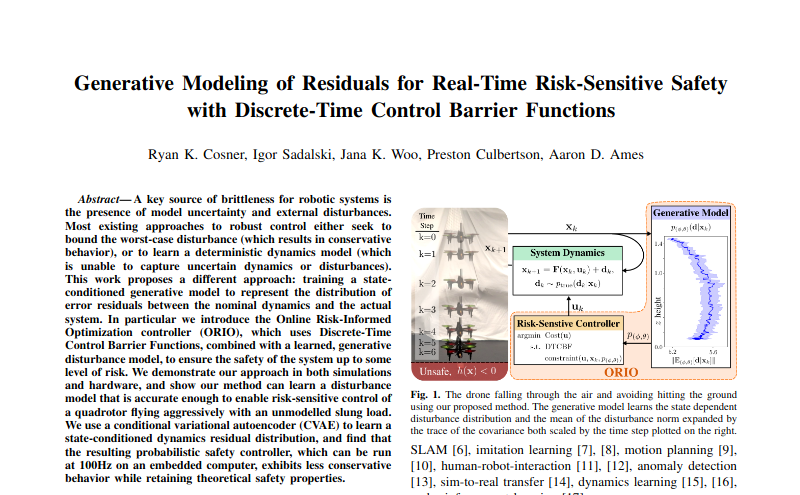
<hr />]]></content><author><name>Ryan K. Cosner</name></author><category term="Research" /><category term="Publications" /><summary type="html"><![CDATA[Alexandre Capone, Ryan K. Cosner*, Aaron D. Ames, and Sandra Hirche.]]></summary></entry><entry><title type="html">ICRA 2024: Generative Modeling of Residuals for Real-Time Risk-Sensitive Safety with Discrete-Time Control Barrier Functions</title><link href="https://www.rkcosner.com/research/4-ICRA-GenerativeModeling/" rel="alternate" type="text/html" title="ICRA 2024: Generative Modeling of Residuals for Real-Time Risk-Sensitive Safety with Discrete-Time Control Barrier Functions" /><published>2023-10-04T12:35:00+00:00</published><updated>2023-10-04T12:35:00+00:00</updated><id>https://www.rkcosner.com/research/4-ICRA-GenerativeModeling</id><content type="html" xml:base="https://www.rkcosner.com/research/4-ICRA-GenerativeModeling/"><![CDATA[<p><strong>Ryan K. Cosner<sup>*</sup></strong>, Igor Sadalski, Jana K. Woo, Preston Culbertson, and Aaron D. Ames.</p>

<p align="center">
<img src="/assets/images/icra23_authors_picture.png
" alt="paper headshot" />
<img src="/assets/images/orio_logo.png
" alt="orio" width="400" />
</p>

<p>Links:</p>
<ul>
  <li><a href="https://drive.google.com/file/d/1h1i2P1oLIH9gGgi2g6ciR3EFWSTiJb7s/view?usp=sharing">extended version pdf</a></li>
  <li><a href="https://arxiv.org/pdf/2311.05802">video</a></li>
  <li><a href="https://colab.research.google.com/drive/1PdD8qGjWKXsrNFoWuth10nI7-SRQ61-r?usp=sharing">colab notebook</a></li>
  <li><a href="https://github.com/rkcosner/icra23_paper_code">github repo</a></li>
</ul>

<hr />

<h2 id="abstract">Abstract</h2>

<p align="justify">
  A key source of brittleness for robotic systems is the presence of model uncertainty and external disturbances. Most existing approaches to robust control either seek to bound the worst-case disturbance (which results in conservative behavior), or to learn a deterministic dynamics model (which is unable to capture uncertain dynamics or disturbances). 
</p>

<p align="justify">
This work proposes a different approach: training a state- conditioned generative model to represent the distribution of error residuals between the nominal dynamics and the actual system. In particular we introduce the Online Risk-Informed Optimization controller (ORIO), which uses Discrete-Time Control Barrier Functions, combined with a learned, generative disturbance model, to ensure the safety of the system up to some level of risk. 
</p>

<p align="justify">
We demonstrate our approach in both simulations and hardware, and show our method can learn a disturbance model that is accurate enough to enable risk-sensitive control of a quadrotor flying aggressively with an unmodelled slung load. We use a conditional variational autoencoder (CVAE) to learn a state-conditioned dynamics residual distribution, and find that the resulting probabilistic safety controller, which can be run at 100Hz on an embedded computer, exhibits less conservative behavior while retaining theoretical safety properties.
</p>

<hr />

<h2 id="extended-paper-version">Extended Paper Version</h2>

<p align="center">
<a href="https://drive.google.com/file/d/1h1i2P1oLIH9gGgi2g6ciR3EFWSTiJb7s/view?usp=sharing"> 
<img src="/assets/images/icra23_paper_headshot.png
" alt="paper headshot" style="border:1px solid black" />
</a>
</p>

<hr />

<h2 id="project-video">Project Video</h2>
<p align="center">
<iframe src="https://drive.google.com/file/d/1cWbQ8rvKEUbG7617Muvp86xPz6d6YM_n/preview" width="630" height="360" allow="autoplay"></iframe>
</p>

<hr />

<h2 id="acknowledgements">Acknowledgements</h2>
<p align="justify">
Special thanks to Albert Li for his help with understanding and coding the CVAEs and to Amy Li for her insightful feedback on our manuscript. This work was also supported by BP. 
</p>

<hr />]]></content><author><name>Ryan K. Cosner</name></author><category term="Research" /><category term="Publications" /><summary type="html"><![CDATA[Ryan K. Cosner*, Igor Sadalski, Jana K. Woo, Preston Culbertson, and Aaron D. Ames.]]></summary></entry><entry><title type="html">L-CSS 2024: Bounding Stochastic Safety:: Leveraging Freedman’s INequality with Discrete-Time Control Barrier Functions</title><link href="https://www.rkcosner.com/research/1-CDC-Max/" rel="alternate" type="text/html" title="L-CSS 2024: Bounding Stochastic Safety:: Leveraging Freedman’s INequality with Discrete-Time Control Barrier Functions" /><published>2023-10-04T12:35:00+00:00</published><updated>2023-10-04T12:35:00+00:00</updated><id>https://www.rkcosner.com/research/1-CDC-Max</id><content type="html" xml:base="https://www.rkcosner.com/research/1-CDC-Max/"><![CDATA[<p>Max H. Cohen, <strong>Ryan K. Cosner<sup>*</sup></strong>, and Aaron D. Ames.</p>

<!-- <p align="center">
<img src="/assets/images/icra23_authors_picture.png
" alt="paper headshot"
/>
<img src="/assets/images/orio_logo.png
" alt="orio" width="400"
/>
</p> -->

<p><em>Accepted as a L-CSS paper with a presentation at CDC 2024</em></p>

<p>Links:</p>
<ul>
  <li><a href="https://ieeexplore.ieee.org/abstract/document/10552758">Official IEEE Xplore Version</a></li>
  <li><a href="https://arxiv.org/pdf/2406.02709">Free arXiv Version</a>
<!-- - [video](https://drive.google.com/file/d/1cWbQ8rvKEUbG7617Muvp86xPz6d6YM_n/preview) -->
<!-- - [colab notebook](https://colab.research.google.com/drive/1PdD8qGjWKXsrNFoWuth10nI7-SRQ61-r?usp=sharing) -->
<!-- - [github repo](https://github.com/rkcosner/icra23_paper_code)  --></li>
</ul>

<hr />

<h2 id="abstract">Abstract</h2>

<p align="justify">
Certifying the safety of nonlinear systems, through the lens of set invariance and control barrier functions (CBFs), offers a powerful method for controller synthesis, provided a CBF can be constructed. This paper draws connections between partial feedback linearization and CBF synthesis. We illustrate that when a control affine system is input-output linearizable with respect to a smooth output function, then, under mild regularity conditions, one may extend any safety constraint defined on the output to a CBF for the full-order dynamics. These more general results are specialized to robotic systems where the conditions required to synthesize CBFs simplify. The CBFs constructed from our approach are applied and verified in simulation and hardware experiments on a quadrotor.
</p>

<hr />]]></content><author><name>Ryan K. Cosner</name></author><category term="Research" /><category term="Publications" /><summary type="html"><![CDATA[Max H. Cohen, Ryan K. Cosner*, and Aaron D. Ames.]]></summary></entry><entry><title type="html">L-CSS 2024: Bounding Stochastic Safety:: Leveraging Freedman’s INequality with Discrete-Time Control Barrier Functions</title><link href="https://www.rkcosner.com/research/4-CDC-Bounded/" rel="alternate" type="text/html" title="L-CSS 2024: Bounding Stochastic Safety:: Leveraging Freedman’s INequality with Discrete-Time Control Barrier Functions" /><published>2023-10-04T12:35:00+00:00</published><updated>2023-10-04T12:35:00+00:00</updated><id>https://www.rkcosner.com/research/4-CDC-Bounded</id><content type="html" xml:base="https://www.rkcosner.com/research/4-CDC-Bounded/"><![CDATA[<p><strong>Ryan K. Cosner<sup>*</sup></strong>, Preston Culbertson, and Aaron D. Ames.</p>

<!-- <p align="center">
<img src="/assets/images/icra23_authors_picture.png
" alt="paper headshot"
/>
<img src="/assets/images/orio_logo.png
" alt="orio" width="400"
/>
</p> -->

<p><em>Accepted as a L-CSS paper with a presentation at CDC 2024</em></p>

<p>Links:</p>
<ul>
  <li><a href="https://ieeexplore.ieee.org/abstract/document/10547223">Official IEEE Xplore Version</a></li>
  <li><a href="https://arxiv.org/pdf/2403.05745">Free Extended arXiv Version</a>
<!-- - [video](https://drive.google.com/file/d/1cWbQ8rvKEUbG7617Muvp86xPz6d6YM_n/preview) -->
<!-- - [colab notebook](https://colab.research.google.com/drive/1PdD8qGjWKXsrNFoWuth10nI7-SRQ61-r?usp=sharing) -->
<!-- - [github repo](https://github.com/rkcosner/icra23_paper_code)  --></li>
</ul>

<hr />

<h2 id="abstract">Abstract</h2>

<p align="justify">
When deployed in the real world, safe con-
trol methods must be robust to unstructured uncertainties such as modeling error and external disturbances. Typical robust safety methods achieve their guarantees by always assuming that the worst-case disturbance will occur. 
</p>

<p align="justify">
In contrast, this paper utilizes Freedman’s inequality in the context of discrete-time control barrier functions (DTCBFs) and c-martingales to provide stronger (less conservative) safety guarantees for stochastic systems. Our approach accounts for the underlying disturbance distribution instead of relying exclusively on its worst-case bound and does not require the barrier function to be upper-bounded, which makes the resulting safety probability bounds more useful for intuitive safety constraints such as signed distance. 
</p>

<p align="justify">
We compare our results with existing safety guarantees, such as input-to-state safety (ISSf) and martingale results that rely on Ville’s inequality. When the assumptions for all methods hold, we provide a range of parameters for which our guarantee is stronger. Finally, we present simulation examples, including a bipedal walking robot, that demonstrate the utility and tightness of our safety guarantee.
</p>

<hr />]]></content><author><name>Ryan K. Cosner</name></author><category term="Research" /><category term="Publications" /><summary type="html"><![CDATA[Ryan K. Cosner*, Preston Culbertson, and Aaron D. Ames.]]></summary></entry><entry><title type="html">Library</title><link href="https://www.rkcosner.com/library/research-library/" rel="alternate" type="text/html" title="Library" /><published>2022-06-14T00:00:00+00:00</published><updated>2022-06-14T00:00:00+00:00</updated><id>https://www.rkcosner.com/library/research-library</id><content type="html" xml:base="https://www.rkcosner.com/library/research-library/"><![CDATA[<p>Here is a list of some of the quotes and published works that inspire our research.</p>

<h2 id="quotes">Quotes</h2>
<ul>
  <li>“What would Tadashi Hamada do?”</li>
  <li>“All models are wrong, but some are useful” - George E. P. Box</li>
  <li>“Anything that can go wrong will go wrong” - Murphy’s Law</li>
  <li>“Sometimes proving things in control theory is like playing Pokemon. You could try and catch them all, but that’s not really the point.” - Andrew Taylor</li>
  <li>“Just because the result is correct, it does not mean it should be published” - Magnus Egerstedt</li>
  <li>“Code is cheap, show me the hardware” - Magnus Egerstedt</li>
  <li>“Ultimately, a PhD is an acadedmic program. It’s goal is not to produce <strong><em>research</em></strong> it is to produce <strong><em>researchers</em></strong>. If you come in everyday and learn something knew, then you’re succeeding” - Raffaello D’Andrea</li>
</ul>

<hr />

<hr />

<h2 id="books">Books</h2>
<ul>
  <li><a href="http://thuvien.thanglong.edu.vn:8080/dspace/bitstream/TLU-123456789/113/1/TVS.000513-%20Convex%20optimization%20Stephen%20Boyd-TT.pdf">Convex Optimization</a>. Stephen Boyd and Lieven Vandenberghe. 2004.</li>
  <li><a href="https://people.duke.edu/~hpgavin/SystemID/References/Astrom-Feedback-2006.pdf">Feedback Systems: An introduction for Scientists and Engineers</a>. Karl Johan Astrom and Richard Murray. 2010.</li>
  <li><a href="https://d1wqtxts1xzle7.cloudfront.net/30694650/PresentationViabilityTheoryNewDirections-libre.pdf?1390966530=&amp;response-content-disposition=inline%3B+filename%3DViability_Theory_New_Directions.pdf&amp;Expires=1655236202&amp;Signature=TrgtVSBrF-nUSROfN~dhoXww5Q0Dn9Pwpz~iLHCiSnWoj7FygjzW8l~DZ5pt9P0YC88LxbclmaVqeMssWBx~kLbJWHgHn-OYHieIHePMmBaVe~jzaujtr1VFewMdFXj5GqsvRbkXLc4uSW5ErdmeIM1gNuj055a1TdPKa6Y5cQ5Q17E7BdabfcmSBw6nyq~mDIGx-C33e93WhLdlwvl0e7gFaIZxAX7c-llgzviTg4L-ipQFzCM90A3ccuvQCSuMzi3a7smNQ0SQ6u6bx-vwsjQojx5W15iYjzhFRYN-oG6ieeVeCjL3tojLfG669ybaV~pWEIipy7gwU9~M2qdosA__&amp;Key-Pair-Id=APKAJLOHF5GGSLRBV4ZA">Viability Theory: New Directions</a>. Jean-Pierre Aubin, et al. 2011.</li>
  <li><a href="https://flyingv.ucsd.edu/krstic/files/Khalil-3rd.pdf">Nonlinear Systems</a>. Hassan Khalil. 2002.</li>
  <li><a href="https://docs.ufpr.br/~danielsantos/ProbabilisticRobotics.pdf">Probabilistic Robotics</a>. Sebastian Thrun, Wolfram Burgard, Dieter Fox. 2005.</li>
  <li><a href="https://books.google.co.jp/books?id=G3ig-0M4wSIC&amp;printsec=copyright&amp;redir_esc=y#v=onepage&amp;q&amp;f=false">Probability and Random Processes</a>. Geofrrey Grimmet, David Stirzaker. 1982.</li>
  <li><a href="https://sites.google.com/berkeley.edu/mpc-lab/mpc-course-material">Predictive Control for Linear and Hybrid Systems</a>. Francesco Borrelli, Alberto Bemporad, Manfred Morari. 2017.</li>
</ul>

<hr />

<hr />

<h2 id="selected-articles">Selected Articles</h2>

<ul>
  <li><strong>Control Barrier Functions (CBFs)</strong>
    <ul>
      <li><a href="https://web.archive.org/web/20190427094405id_/https://authors.library.caltech.edu/79450/2/1609.06408.pdf">Control Barrier Function Based Quadratic Programs for Safety Critical Systems</a>. Aaron Ames, et al. 2017.</li>
      <li><a href="https://arxiv.org/pdf/1908.09323">Characterizing Safety: Minimal Barrier Functions from Scalar Comparison Systems</a>. Rohit Konda, et al. 2019.</li>
      <li><a href="https://par.nsf.gov/servlets/purl/10057932">Nonsmooth Barrier Functions with Applications to Multi-Robot Systems</a>. Paul Glotfelter, et al. 2017.</li>
      <li><a href="https://par.nsf.gov/servlets/purl/10057932">Exponential Control Barrier Functions for Enforcing High Relative-Degree Safety-Critical Constraints</a>. Quan Hguyen and Koushil Sreenath. 2016.</li>
    </ul>
  </li>
  <li><strong>Robust Nonlinear Control</strong>
    <ul>
      <li><a href="http://www.sontaglab.org/FTPDIR/04cetraro.pdf">Input to State Stability: Basic Concepts and Results</a>. Eduardo D Sontag. 2008.</li>
      <li><a href="https://scholar.archive.org/work/gkb3u6rydbcxdilup3txjsfupi/access/wayback/https://authors.library.caltech.edu/87777/2/1803.03035">Input-to-State Safety with Control Barrier Functions</a>. Shishir Kolathaya and Aaron Ames. 2018.</li>
    </ul>
  </li>
  <li><strong>Set Invariance</strong>
    <ul>
      <li><a href="https://www.jstage.jst.go.jp/article/ppmsj1919/24/0/24_0_551/_article">Über die Lage der Integralkurven gewöhnlicher Differentialgleichungen</a>. Mitio Nagumo. 1942.</li>
      <li><a href="https://www.jstor.org/stable/pdf/2316263.pdf?casa_token=AvhsmlWL1jMAAAAA:Lee4UWyZ91xMMK4Ne_GkD7UwMeiYHzcGkRZp8rUU06tJkDu8GVacFxdmxSt9N70pD0vgPnJytCUK4hjSnYq9FOnA1rYoVOtoccE6k6TndPdsnYhzxyBQ">The theorems of Bony and Brezis on Flow-Invariant Sets</a>. RM Redheffer. 1972.</li>
    </ul>
  </li>
  <li><strong>Preference Based Learning</strong>
    <ul>
      <li><a href="https://arxiv.org/pdf/1909.12316">Preference-based Learning for Exoskeleton Gait Optimization</a>. Maegan Tucker, et al. 2020.</li>
    </ul>
  </li>
  <li><strong>Imitation Learning</strong>
    <ul>
      <li><a href="https://arxiv.org/pdf/1709.07174.pdf">Agile Autonomous Driving Using End-to-End Deep Imitation Learning</a>. Yunpeng Pan, et al. 2019.</li>
    </ul>
  </li>
  <li><strong>Linear Control</strong>
    <ul>
      <li><a href="https://authors.library.caltech.edu/93672/1/01101812.pdf">Guaranteed Margins for LQG Regulators</a>. John Doyle. 1978.</li>
    </ul>
  </li>
</ul>]]></content><author><name>Ryan K. Cosner</name></author><category term="Library" /><category term="Library" /><summary type="html"><![CDATA[Here is a list of some of the quotes and published works that inspire our research.]]></summary></entry></feed>